Velocity-Based Training and Longevity-Relevant Outcomes
Velocity-Based Training for Healthy Aging
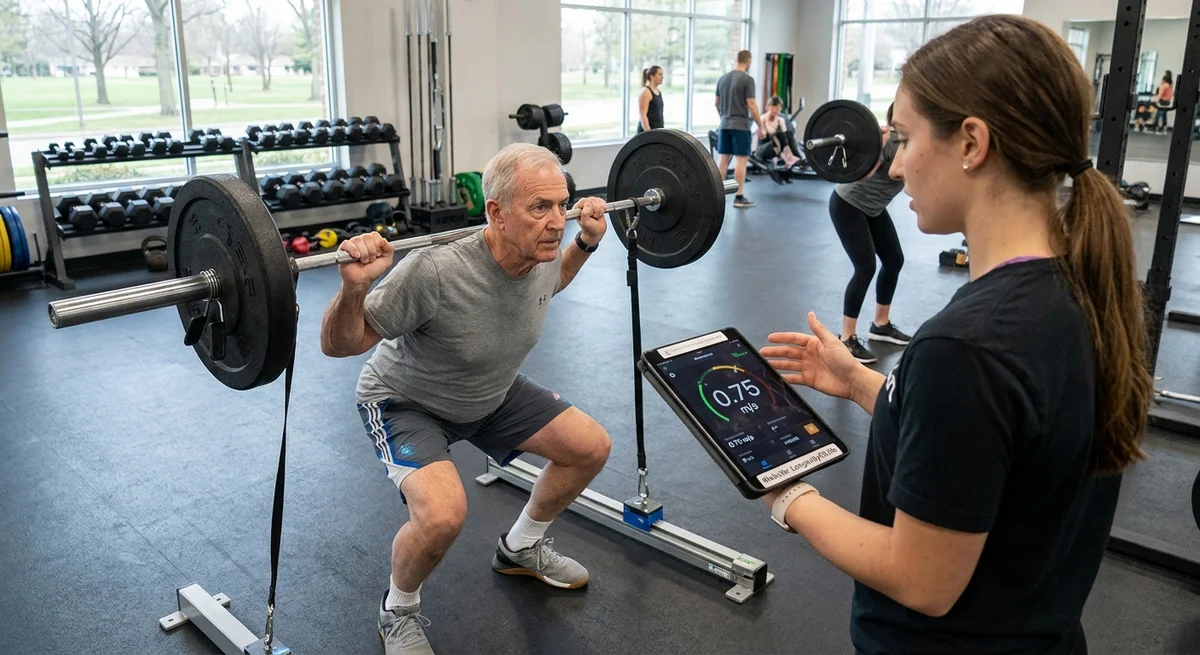
As we grow older, keeping muscles strong and fast is key to staying active and independent. Velocity-based training (VBT) means watching how quickly we lift weights. Instead of only focusing on heavy lifts, we try to move weights as fast as safely possible. This approach has shown promise for improving strength, power, and everyday abilities (like walking speed and standing up from a chair) that matter for healthy aging. Researchers have begun testing whether monitoring bar speed – and stopping sets when lifts slow down by a set amount (a velocity loss target) – can boost strength and functional outcomes in older adults (www.sciencedirect.com) (suppr.wilddata.cn).
Several small trials of older adults suggest yes. In one 12-week study of very old adults (average age ~82) with slow walking speed, a power-training program (lifting heavy but moving fast) improved leg strength and even increased maximum walking speed by about 0.12 m/s (www.sciencedirect.com). This is meaningful: every extra 0.1 m/s in gait speed is linked to a 12% lower risk of death in older people (pmc.ncbi.nlm.nih.gov). Another pilot trial had seniors do arm exercises as fast as possible for 10 weeks. They saw significant improvements in walking speed by the end (www.dovepress.com). In short, moving any weights quickly can help translate to better walking.
A recent systematic review of 79 trials found that fast lifting beats slow lifting for many daily tasks in older adults (academic.oup.com). High-speed training gave bigger gains in fast walking speed, timed up-and-go tests, and quick chair stands – measures tied to mobility and independence (academic.oup.com). (By contrast, very heavy slow lifts did better for some endurance tests like how many sit-stands you can do in 30 seconds (academic.oup.com).) This means if you want to get stronger at walking and standing up quickly, training with speed is especially helpful (academic.oup.com).
What Is Velocity-Based Training?
VBT is simple: use a device (or smartphone app) to measure bar or body speed during each rep. Each session, you might have a “velocity loss” cutoff – for example, stop a set when you slow down by 10–20% from your first rep (www.sciencedirect.com). This keeps you from pushing so hard that your form breaks down. For example, if your first rep of a squat moves 0.50 m/s, stopping at a 10% loss means ending the set once speed drops to ~0.45 m/s. Even if no device is handy, you can focus on lifting “as fast as possible” each rep, and stop when you feel your speed or power drop too much.
Using bar speed keeps training intense but short. It helps you do many reps at a strong effort without burning out. For older adults with limited energy, this can be safer and more fun than long, grueling sets. Plus, studies show that stopping at a small velocity loss still improves strength and functional skills. In one trial, seniors who stopped each squat or chest press set at only 10% speed loss gained leg strength, pressing speed, and were able to stand up from a chair faster (www.sciencedirect.com). Those who stopped at 20% loss saved more reps (and time) and also improved walking speed and grip strength (www.sciencedirect.com).
Winning Speed for Strength and Function
Why does speed help? As we age, muscles tend to slow down, and everyday tasks like catching your balance or hurrying to cross a street rely on quick movements. High-speed training boosts power (how fast force is produced), which is crucial. Research finds that in layered everyday tests, older folks are more limited by how fast they can move than by raw strength (suppr.wilddata.cn) (pmc.ncbi.nlm.nih.gov). For example, one study found that to really improve function, seniors needed to train with an average limb movement of about 0.88 m/s (nearly 1 m/s) during power exercises (suppr.wilddata.cn). Hitting that speed seemed key to walking faster and getting stronger.
In practical terms, pushing weights quickly translates to better walking and rising speed later. Power training studies (where older adults do fast moves) often see big benefits. In one trial, adding fast leg presses and squats improved participants’ treadmill-speed walking and muscle activation (www.sciencedirect.com). In another small study, focusing on fast upper-body moves (like rapid chest presses) still improved full-body outcomes like gait speed (www.dovepress.com). This happens because moving quickly engages the neuromuscular system in an “explosive” way, making the brain-muscle connection stronger.
Using RPE as a Simple Proxy for Speed
Not everyone has a fancy speed meter, so how can we approximate velocity-based training? The answer is RPE – Rate of Perceived Exertion – on a 1–10 scale based on how hard a set feels. Studies have found that RPE (especially a version called “reps-in-reserve” scale) lines up very well with bar speed (journals.lww.com). In one experiment, trained adults doing 1-rep max tests showed very strong links between RPE and actual lift velocity (correlation around -0.8 to -0.9) (journals.lww.com). In simple terms, as a rep slows (hard to push), your RPE goes up.
So, a simple way: perform each rep at maximum safe speed, and stop the set around RPE 7–8 (meaning you feel you have about 2–3 reps still left). This typically means your speed has only dropped modestly (roughly matching a 10–20% velocity loss (www.sciencedirect.com) (journals.lww.com)). In practice, it might sound like: “Stop when you feel you could do only two more reps if you pushed.” This humble rule-of-thumb mirrors what velocity devices would tell you. For example, one coaching article notes that using RPE and velocity together can inform training load and stopping points (journals.lww.com).
In summary, no gear needed: just lift each rep as fast as you can, and quit the set when your pace or form noticeably slows. You’ll get the same drop in bar speed as cutting at the 10–20% marks (www.sciencedirect.com) (journals.lww.com). Over time, you will also “re-calibrate” how fast different RPE feels – the more you do it, the better you gauge it.
Building a Velocity-Focused Workout
To apply these ideas, older trainees (or their trainers) can structure workouts like this:
- Exercises: Choose 3–4 movements hitting major muscle groups. Good choices are leg press (or sit-to-stand), squats to a chair, chest press (or wall push-ups), and seated row (or band rows). Always have a safe setup (for example, squat near a support).
- Loads: Use moderate weight – roughly 40–65% of your one-rep max (the max you could lift once). If you do not know your 1RM, use a weight you can comfortably lift 8–12 times with effort. (Research protocols often used ~50% of 1RM for older adults (www.sciencedirect.com).)
- Sets & Reps: Do 2–3 sets of each exercise. Perform about 8–12 reps per set, but pay attention to speed.
- Speed: On every rep, push or lift as fast as safely possible. It should feel “explosive” – for instance, explode up from a squat or press the weight up quickly.
- Stopping Rule: Stop each set when you notice you can no longer move fast. This might be when you feel you could only do 1–2 more reps (RPE ~8), or roughly when the bar speed has dropped ~10–20% from its best. Either way, end the set before full fatigue sets in (www.sciencedirect.com) (journals.lww.com).
- Rest: Take full breaks between sets (1–2 minutes or more) so you’re ready to go fast each set. This helps keep each rep speedy.
- Frequency: Aim for 2–3 sessions per week (with rest days between), as was done in studies.
For example, a sample session might be:
- 3 sets of 10 fast-chair squats (sit lightly on chair, then stand up explosively; stop each set when form slows).
- 3 sets of 10 fast chest presses (with dumbbells or machine; press up quickly).
- 3 sets of 10 fast leg presses or sit-stand practice.
- 3 sets of 10 band rowing or arms pulls at speed.
The exact exercises can vary, but the key is quality (speed) over quantity. Studies noticed big gains even with these modest schemes. One trial even found doing just 2–3 sets of ~8–12 reps at moderate load, with 10% velocity loss, boosted leg press power and sit-to-stand times (www.sciencedirect.com). Using 20% loss added benefits for walking speed and grip strength (www.sciencedirect.com). Tailor the threshold: if you mainly want to improve sit-stand and pressing speed, use the 10% rule; if gait speed is a key goal too, try accepting up to ~20% loss per set in a few sets (www.sciencedirect.com).
If you cannot measure loss, just stop when you sense a strong drop in speed. The feel-based pause is usually when RPE ~8. Over each week, you can try to gently increase weight or reps but always keep the focus on fast reps.
Moving Faster, Living Better
In sum, evidence is growing that moving weights quickly – and watching for slowing down – can improve longevity-relevant outcomes. Faster walking speed and quicker chair-rise are linked to independence and longer life (pmc.ncbi.nlm.nih.gov). By using velocity-based cues, older exercisers can train their muscles and nerves to fire faster, which pays off in daily life. Unlike pushing to full exhaustion, VBT encourages stopping before huge fatigue, making it more enjoyable and less risky.
For older adults looking to stay strong and mobile, velocity-based training offers clear guidance: be explosive, be safe, and listen to your body. Using either a speed sensor or just good old RPE, you can fine-tune your workouts. Starting at around 40–60% effort and going fast can be surprisingly effective and fun. Over months, as studies show, this can lead to measurable improvements in strength, power, and walking speed (www.sciencedirect.com) (www.sciencedirect.com).
Remember, any exercise is better than none. But if you or a loved one are doing resistance training, try adding some zip into each lift and see the difference. With each quick rep, you’re training not just muscles, but the ability to move well years into the future – which is a gift of longer, healthier living (pmc.ncbi.nlm.nih.gov) (academic.oup.com).
Get New Longevity Research & Podcast Episodes
Subscribe to receive new research updates and podcast episodes about longevity, fitness, healthspan, healthy aging, nutrition, supplements, and practical lifestyle optimization.