Wearables and Computer Vision: Measuring Real-World Resistance Training Exposure
Wearables and Computer Vision in Resistance Training
Staying active is important for a long, healthy life. Today’s wearable devices and smartphone apps can help us track strength workouts and understand their benefits. For example, a fitness tracker on your wrist can sense movement, or a phone camera can even watch you do a push-up. By collecting this real-world exercise data, researchers link workout habits to health outcomes like illness and longevity. In this article, we explain how new technology can detect and measure strength training (resistance training) sessions, how those estimates relate to health, and what simple tips anyone can use to track workouts effectively.
How Wearable Tech and AI Track Exercise
Modern tools make tracking workouts easier. Here are three approaches researchers and fitness apps use to spot strength workouts and measure their intensity:
-
Wrist accelerometers: Many fitness bands and watches contain accelerometers (tiny motion sensors). They measure how your wrist moves in three directions. Over a week, devices like those used in the UK Biobank study collected continuous motion data from over 90,000 people (cambridgebrc.nihr.ac.uk). Experts can use this acceleration data to spot patterns (like lifting or lowering arms and legs) that match strength exercises. For example, repetitive swinging motions or changes in wrist angle can hint at curls, squats, or presses. The UK Biobank project showed that asking people to wear these sensors for one week provides rich data on daily activity (cambridgebrc.nihr.ac.uk). Smart algorithms analyze the raw signals (after removing noise and gravity effects) to estimate how much muscle-work someone did.
-
Heart rate monitors: Many wearables (or chest strap heart monitors) measure your heart’s beats per minute. During exercise, heart rate rises. While heart rate alone can’t identify what exercise you’re doing, it indicates intensity. A sudden jump in heart rate in the middle of a session might show you started lifting heavier weights or doing intense circuits. Combining heart rate data with the accelerometer signals can help distinguish a fast-paced jogging run from a strength workout. In practice, a session with lots of arm/leg motion and a high heart rate likely means hard exercise. Thus, beyond counting steps, smart trackers use heart-rate and accelerometer together to estimate a “workout” is happening and how intense it is.
-
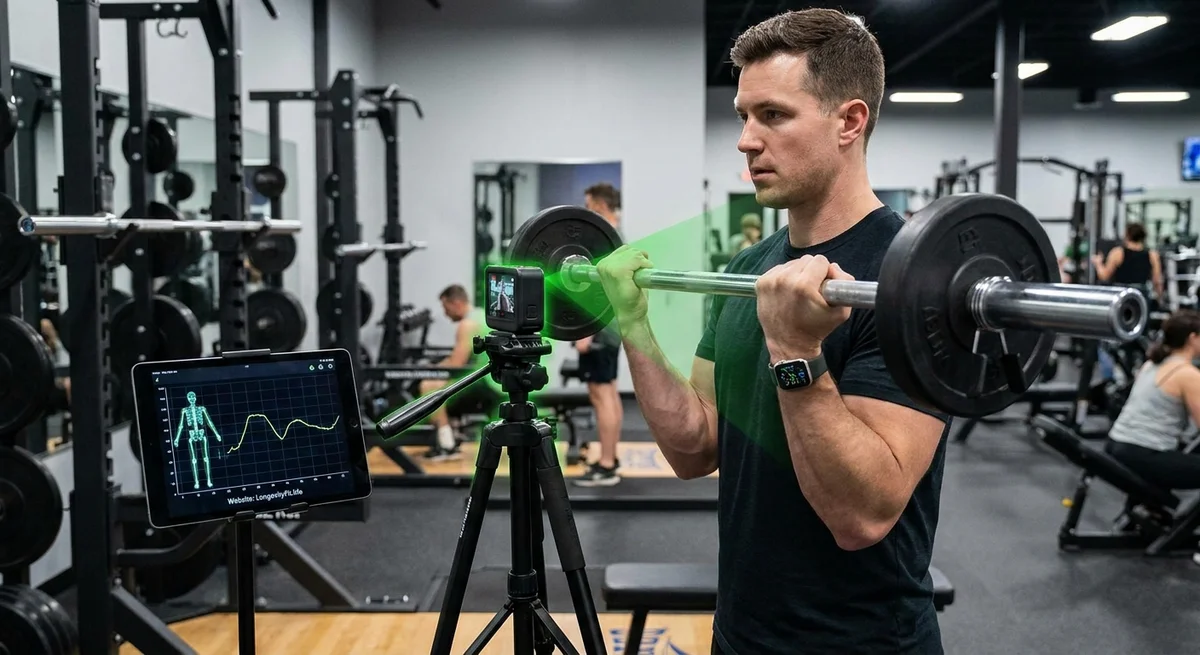
Smartphone video and computer vision: Advances in AI let a phone’s camera see and interpret exercise. Pose estimation models like Google’s PoseNet can detect body parts (elbows, knees, wrists) in real-time from video (blog.tensorflow.org). In simple terms, the app figures out where your joints are. Then it can recognize a move (e.g. as you squat down your knees bend and you lean forward). A recent study notes that “AI-driven pose estimation offers a scalable and cost-effective solution to track exercises in mobile health apps” (pmc.ncbi.nlm.nih.gov). Practically, this means an app could count squats, lunges, or push-ups by watching you on the screen. For instance, if the camera sees you bending your knees and then standing, it can identify that pattern as a squat repetition. Many new fitness apps use this idea: you film yourself exercising and the software gives feedback or counts reps. This computer vision approach is promising for weights or bodyweight moves, because it can directly detect the posture and motion rather than just overall wrist movement.
Each method alone has pros and cons. A wrist sensor is convenient (just wear it), but it might miss exercises where the wrist barely moves (like planks) or confuse arm swings with true lifts. Heart rate adds intensity info but can lag behind activity. Video analysis can be very accurate in ideal conditions (good light and angle), but needs you to set up the camera and use battery. Researchers often combine these sources. For example, if the watch data shows an unusual arm lift pattern and camera sees a bicep curl, the app is very confident a curl happened. In ongoing projects, scientists pair the UK Biobank’s wrist accelerometer data with heart-rate readings and video from phones to build and refine detection algorithms. These algorithms are trained on labeled data: volunteers do known exercises while being recorded, so the software learns the “signature” of each move. Then in everyday life (like doing a home workout), the algorithm can identify and count those moves from the sensor data or video feed.
Linking Exercise to Health Outcomes
Why do we care about measuring workouts so precisely? Because stronger, fitter people tend to live longer and healthier lives. Multiple major studies show that muscle-strengthening exercise (like weight lifting or calisthenics) lowers the risk of chronic diseases and death. For example, a large review found that adults doing regular strength workouts had a 10–17% lower risk of death from any cause, as well as lower risk of heart disease, diabetes, and some cancers (bjsm.bmj.com). In one news report on nearly 100,000 people, those lifting weights once or twice a week reduced their risk of death (from any cause except cancer) by about 9% (time.com). The benefit is even larger if you also do aerobic exercise: combining 1-2 days of weight lifting with regular walking/jogging cut the death risk by over 40% (time.com). Health agencies now recommend including strength exercises as part of a healthy routine. The U.S. Centers for Disease Control (CDC) says adults should do muscle-strengthening workouts on 2 or more days a week, in addition to aerobic exercise (www.cdc.gov). World Health Organization guidelines agree: at least two sessions weekly to work all major muscle groups (www.ncbi.nlm.nih.gov). These targets match the science: benefits were strongest at moderate levels of strength training (about 30–60 minutes per week) (bjsm.bmj.com). Doing more also helps, but with diminishing returns.
Big data from wearables is now used to refine dose–response models. This means scientists can more accurately say “X minutes of strength exercise cuts disease risk by Y%.” For example, in UK Biobank research with 80,000+ people, raw accelerometer data on activity (including intensity) turned out to be one of the top predictors of mortality after age (pure.johnshopkins.edu). In fact, minutes of brisk activity and overall movement measured by the wrist were nearly as predictive of death risk as getting older (pure.johnshopkins.edu). This shows the promise of objective measurements: rather than asking people how much they exercised (which can be wrong), the devices provide reliable exposure data that can be linked to medical records. Researchers use such linked data to see exactly how different activity levels relate to outcomes like heart attacks, diabetes, or longevity. As these large studies unfold, we expect to get clearer answers on how much and what kind of resistance training yields the most health benefit.
Dealing with Measurement Challenges
No measurement tool is perfect. Wrist devices might miss isometric holds (like planks) or mislabel rhythmic chores as exercise. Phone camera analysis can be blocked if someone steps out of frame. Even self-reports (logging exercise by writing notes) can be forgotten or exaggerated. To get accurate exercise exposure estimates, researchers must account for these errors. One approach is regression calibration – a statistical method that “corrects” the naive measurements. In plain terms, scientists study a smaller group with very accurate measurements (for instance, directly observing and timing a workout) and compare those to the device data or diary records. They then use regression models to adjust (calibrate) the larger dataset. This way, if a tracker tends to undercount reps by 10%, the results get mathematically corrected. In application, this means linking wearable data to known standards or cross-checking with heart-rate response. The advantage is a refined dose–response curve: after calibration, we have more confidence that “30 minutes” recorded by the app truly reflects real exertion time. Ultimately, this careful processing helps ensure that the association between tracked exercise and health outcomes is as accurate as possible.
Practical Tips for Self-Tracking and Healthy Habits
Tracking workouts can be as simple or fancy as you like. Here are some practical suggestions and goals based on current evidence:
-
Aim for at least 2 strength workouts per week. Health guidelines and studies agree that two or more days of muscle-strengthening exercises per week yields clear benefits (www.cdc.gov) (www.ncbi.nlm.nih.gov). These can be weight machines, free weights, resistance bands, or bodyweight moves (push-ups, squats, etc.). Even a short 20–30 minute session counts towards the weekly total.
-
Use a wearable or app if possible. Many people already wear smartwatches or fitness trackers. For example, a modern smartwatch can track your heart rate continuously and record “workout” periods. If your device has a workout mode, start it when you begin lifting. It will record duration and heart-rate zones, which can be very useful later.
-
Try smartphone-based tracking. If you don’t have a tracker, a smartphone app can help. Some apps let you enter exercises manually, while others can use the phone’s camera to automatically detect reps (through AI pose estimation). A study from 2026 showed smartphones with AI can count push-ups and squats by video, depending on camera angle (pmc.ncbi.nlm.nih.gov). Even using your phone’s camera as a mirror while you exercise and then reviewing it can give you feedback. Some free apps can count reps by sound or motion sensors. Even a simple exercise log app (writing "Monday: squats 3x10") will give you a rough record of your volume and progress.
-
Focus on form and consistency, not just tracking software. Technology is helpful, but the main thing is doing the exercises safely. Good form prevents injury and works the target muscles. For consistency, consider setting reminders or tying workouts to routine (e.g. do a quick set of push-ups after brushing teeth). Over time, wearing out-of-the-box solutions like a fitness tracker or smart band will give you data you can later analyze.
-
Set simple goals or badges for motivation. For example, challenge yourself to increase your weekly workout minutes by a small amount each month, or to add one more week of workouts. Some apps let you earn “streak” badges for consecutive days of exercise. These gamification elements keep you motivated.
-
Mind the thresholds of benefit. Research suggests most of the reward comes from reaching those 2+ days a week level (30–60 min/week). Once you are there, every bit more helps but with gradually smaller gap in benefit (bjsm.bmj.com) (www.ncbi.nlm.nih.gov). Don’t feel you must lift for 2 hours each session – even moderate sessions help. The key is making strength training a regular habit.
-
Combine with aerobic activity. While this article focuses on resistance training, recall that the best health results come from combining cardio and strength. People who met both the aerobic (like 150 min walking/running weekly) and strength guidelines had the lowest disease and death risks (time.com) (www.ncbi.nlm.nih.gov). So treat strength workouts as part of an “all-around” exercise plan.
By keeping track of your workouts (whether with a gadget or a journal) and aiming for those minimum targets, you can tap into real health benefits. Remember, just starting is a win – doing resistance exercises even once a week is better than none, and you will gradually build strength and health.
Conclusion
In summary, wearable sensors and AI are opening new doors to measure how much strength training people really do in daily life. Wrist accelerometers, heart-rate monitors, and video analysis can detect and quantify workouts without needing a lab. This high-quality data is now being linked to health studies: more accurately measured exercise lets scientists refine how muscle-building activity relates to illness and lifespan. The good news is clear: regular strength training lowers the risk of diabetes, heart disease, and death (bjsm.bmj.com). With simple tools you might already have (a fitness watch or smartphone), you can track your own resistance workouts and make sure you hit the recommended 2+ days per week (www.cdc.gov) (www.ncbi.nlm.nih.gov). Actionable steps like setting a weekly goal, using a tracking app, or even filming yourself for AI feedback can make sticking to a routine easier. By doing so, you’re investing in long-term health – stronger muscles and bones, better metabolism, and a more robust body overall. Every extra set you do is a step toward that goal, and as science shows, even moderate strength training pays off with better health.
Get New Longevity Research & Podcast Episodes
Subscribe to receive new research updates and podcast episodes about longevity, fitness, healthspan, healthy aging, nutrition, supplements, and practical lifestyle optimization.