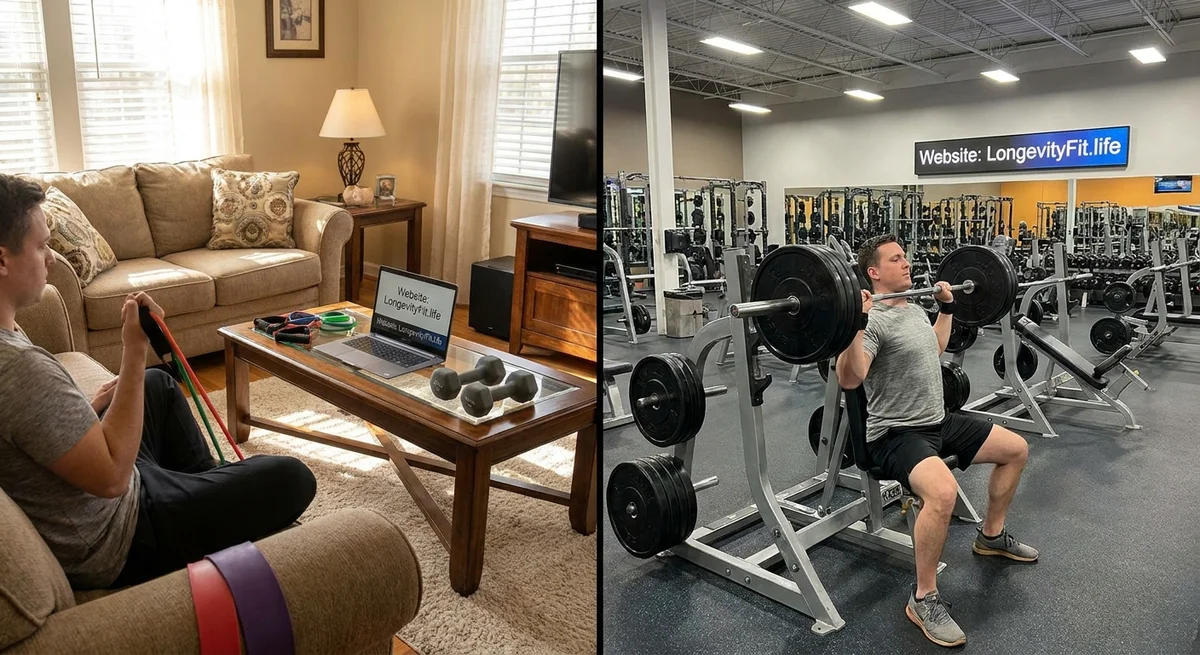
Home-Based vs Gym-Based Resistance Training: Effectiveness and Scalability
Home vs. Gym Resistance Training: Making Strength Work Where You Are
Getting stronger and healthier through resistance training can happen at home or in the gym. In resistance training, you use muscle-strengthening activities like lifting weights, using resistance bands, or doing bodyweight exercises (like push-ups and squats). Experts agree everyone should do resistance training at least 2–3 times per week for all the big muscle groups (exrx.net). This helps bones stay strong, muscles grow, balance improve, and metabolism stay healthy.
Many people wonder: is working out at home as good as working out in a gym? How do results compare in health, sticking with the program (adherence), and costs? Studies and practical trials give us answers. Below, we compare home-based programs (bands, bodyweight, a few dumbbells) to gym-based programs (machines or free weights) using real trial evidence. We also look at how age, fitness level, and health issues affect the outcomes. Finally, we include tips and sample home routines you can start today.
Health Outcomes: Strength and Fitness Gains
Resistance training is good for everyone. It builds muscle, keeps bones strong, and helps with daily tasks like carrying groceries or climbing stairs (pmc.ncbi.nlm.nih.gov) (pubmed.ncbi.nlm.nih.gov). The big finding across many trials is: home programs can improve strength and function almost as well as gym programs.
-
Muscle Strength and Size: Research shows that when home workouts use the same effort as gym workouts, the gains in strength and muscle are very close. In one study, trained adults did 8 weeks of workout with barbells or machine exercises (gym style) vs. exactly the same moves with bars vs. machines. Both groups lifted heavier loads over time and grew muscle about the same amount (pubmed.ncbi.nlm.nih.gov). In other words, whether the weight is free (barbells) or on a gym machine, your muscles got stronger equally. This means if you have dumbbells or a barbell at home, you can match a gym’s results.
-
Older Adults and Functional Fitness: For seniors, simple home exercises work too. For example, a 12-week program of chair-supported exercises with resistance bands helped older women (around age 75) improve their leg and arm strength and even their blood sugar and cholesterol levels (pmc.ncbi.nlm.nih.gov). Their fitness and health markers got better even though the workouts were low-impact and done at home. Another review of home exercise among older people found it was safe and gave modest improvements in leg strength, balance, and power (www.sciencedirect.com). In short, older adults can build strength at home with safe moves and light bands or weights.
-
Mental Health and Quality of Life: Both settings tend to improve mood and quality of life. A year-long trial in adults with chronic conditions found that gym exercise and phone-supported home exercise led to similar quality-of-life scores (pubmed.ncbi.nlm.nih.gov). (Gym exercisers had a tiny edge in depression scores, but the difference was small (pubmed.ncbi.nlm.nih.gov).) This suggests that being active is what counts; whether at home or the gym, people felt better. Social factors in a gym (friends, classes) might give a slight mood boost, but overall health outcomes were alike (pubmed.ncbi.nlm.nih.gov).
-
Special Cases (Sarcopenia, Rehab): Even among people with serious muscle loss (sarcopenia) or mobility issues, home training can work. A trial with older people recovering from muscle loss found a 4-week app-based home program (with guided exercises) improved strength and balance just as well as in-person rehab (pmc.ncbi.nlm.nih.gov). The study concluded remote exercises can be equally effective for these adults (pmc.ncbi.nlm.nih.gov).
In summary, what matters most is the workout effort. Many studies show that if you work the muscles sufficiently, home programs produce strength, health, and fitness benefits close to those from a gym (pubmed.ncbi.nlm.nih.gov) (www.sciencedirect.com). Gym equipment is not magic; bodyweight moves, elastic bands, or free weights can lead to similar gains if done right.
Adherence and Motivation: Sticking With the Program
A key question is not just which setting yields better fitness, but which makes people stick with it. Stopping exercise is a common issue. Research gives useful insights:
-
Similar Long-Term Adherence: One large year-long study found people in a remotely supervised home program stuck with exercise just as well as those in a gym program (pubmed.ncbi.nlm.nih.gov). Both groups kept exercising over 12 months. That suggests if people have support (like phone check-ins), they can keep going at home as often as in the gym.
-
Role of Supervision: In a shorter 10-week trial with younger adults, in-person coaching had the highest adherence (88%) compared to app guidance (81%) and no guidance (52%) (journals.lww.com). This means people tend to do more workouts when someone guides or supervises them. If you’re on your own (self-guided), it's easy to skip workouts. Phone or video coaching and group classes can help motivate home exercisers.
-
Digital Tools Help: Internet and app-based programs boost home exercise. For example, patients given access to a web exercise program (instead of paper instructions) reported doing more of their prescribed exercises (journals.lww.com) (journals.lww.com). A mobile app-based home workout for seniors likewise improved their workout adherence and confidence compared to usual care (journals.lww.com). In short, apps, online videos, or telehealth check-ins can make you more likely to keep working out at home.
-
Making It Fun and Convenient: Home workouts save travel time and are done at your schedule, which many people find easier. Still, gyms offer social support and variety (group classes, machines). Stick rates vary by personal preference. The bottom line: choose what you enjoy most. If you love classes, a gym or live online class may keep you coming back. If you like privacy and convenience, home is great – but use a plan (or app) and maybe a buddy for accountability.
Cost Comparison
Money matters too. Gym memberships can be expensive and often recurring. Home fitness gear a one-time purchase:
-
Gym Costs: Monthly fees (perhaps $30–$100 or more) plus travel costs. A full maintenance gym program can add up. A study found that, when comparing programs, gym-based exercise was more expensive than a home program with phone support (www.sciencedirect.com). It concluded that home training was more cost-effective for maintenance exercise. This makes sense: a gym needs machines, staff, and utilities, whereas a home workout uses your own space.
-
Home Costs: The equipment cost can be quite low. Resistance bands are maybe $10–$30 for a set. A couple of dumbbells or kettlebells cheaper than a year of membership. Many home workouts use bodyweight or household items (like water jugs) for weight. Even if you add an app subscription or occasional virtual trainer sessions, the total is often lower than ongoing gym fees.
-
Overall: If budget is tight, home training wins. The nice part is you only invest upfront and can keep using the gear for years. Gyms give more equipment variety, but at a higher price. The studies show that for similar results, home programs require much less money (www.sciencedirect.com).
Tailoring by Age, Mobility, and Fitness Level
Not everyone has the same needs or starting point. Here’s how home vs. gym can differ for different groups:
Older Adults
-
Benefits Still High: Even seniors in their 70s and 80s see real strength and health gains at home. As noted, chair exercises with bands significantly improved leg strength and health markers in older women (pmc.ncbi.nlm.nih.gov). This kind of program is low-impact and safe for those with joint or balance concerns.
-
Safety: Older people or those with mobility issues should start gently. Chair exercises, wall push-ups, and band movements are good choices. If balance is a concern, sit during exercises or hold onto support. Many success stories exist: e.g., institutionalized older adults improved their function with band exercises (pmc.ncbi.nlm.nih.gov).
-
Motivation and Supervision: Seniors often appreciate structure. Programs done with a weekly check-in (phone or video) or group have better adherence. In one program, 92% of seniors stuck with a 12-week home band-exercise program (pmc.ncbi.nlm.nih.gov), partly because it was well supervised and easy to do.
-
Outcome: Home exercise is very doable. In fact, a 4-week supervised app-based program in older people with muscle loss saw equal strength gains as an in-person program (pmc.ncbi.nlm.nih.gov).
People with Mobility or Health Limitations
-
Chair and Bed Exercises: For people who cannot stand long or have chronic conditions, chair-based strength moves are effective. The chair-band study above (pmc.ncbi.nlm.nih.gov) is a great example. Each exercise is done seated or supported, so even wheelchair users can do versions of them.
-
Gradual Progress: If limited by health (e.g., recovering from injury), start with just a few reps and once a week, then slowly build. Even a little resistance training (like lifting legs against gravity or using very light bands) helps muscle maintenance.
-
Real-World Success: In rehab settings, people using telehealth programs did just as well (or better) than direct rehab for conditions like sarcopenia (severe muscle loss) (pmc.ncbi.nlm.nih.gov). This means a stable home program, possibly with remote coaching, can be a safe substitute when clinics are hard to reach.
Beginners vs. Fit Individuals
-
Beginners: If you are new to exercise, your muscles will respond quickly to almost any resistance work. Bodyweight squats, easy bands, and light dumbbells can make you stronger fast in the first weeks. Even modest home routines (with careful attention to form) can improve fitness in beginners (www.sciencedirect.com).
-
Experienced Lifters: People who lift regularly at high levels may find home workouts a bit limited if they lack heavy weights or machines. However, as seen in an 8-week trial of trained athletes, even advanced lifters grew muscle similarly using barbells at home vs. machines at the gym (pubmed.ncbi.nlm.nih.gov). The key was using similar loads. If you have heavy free weights at home, you can match gym progress.
-
Customizing Intensity: If you’re fit and want to progress at home, you may need strategies: heavier resistance bands, slower reps, or adding weight (like a backpack). Also, exercise choice matters: for example, if you want to challenge quads like gym leg press, do full squats and lunges with added weight. A study shows that well-planned programs can make home training effective even for fit people (pubmed.ncbi.nlm.nih.gov) (journals.lww.com).
Digital Coaching and Telehealth: Boosting Home Workouts
Modern tech bridges home and gym:
-
Apps and Online Programs: There are many free or paid apps that create strength routines and track your progress. These can remind you of workouts and adjust difficulty. Studies find they help. For example, a telehealth app for older adults gave outcomes equal to face-to-face therapy (pmc.ncbi.nlm.nih.gov). And a web-based exercise system made patients do more of their home exercises than usual paper instructions (journals.lww.com).
-
Virtual Trainers: Video calls with a trainer let you get feedback on form and stay accountable. Even recorded classes or YouTube workouts provide guidance. When people feel watched or supported (even through a screen), they tend to do more reps and workouts.
-
Social Online Groups: Some rely on live classes or group chats for motivation. Sharing progress with friends can improve adherence. During the pandemic, many joined streamed fitness classes and stuck with routines at home.
-
Hybrid Models: One good approach is mixing gym and home. For instance, you might have a gym session once a week and do two home workouts. Or a coach might meet you once monthly and assign home workouts the rest of the time. Research on combined models is limited but suggests people enjoy flexibility.
The data shows digital support makes home training work. People are more likely to keep at it, and they learn better technique with some guidance. It effectively narrows the gap with gym training.
Sample Home Resistance Training Programs
Getting started at home is easy with a plan. Here are two example programs you can adapt. They use bodyweight and basic equipment (bands, dumbbells, chair). These follow expert guidelines (covering all main muscle groups, 8–12 reps per exercise, 2–3 sets) (exrx.net).
1. Full-Body Basic Home Workout (Bands/Bodyweight)
Do this routine 2–3 times per week, with at least one rest day between sessions:
- Warm-up (5–10 min): March or jog in place, gentle arm circles.
- Squats or Sit-to-Stand (legs): 2–3 sets of 8–12 reps. Start by standing up/sitting down from a chair. Progress to full squats. Use a band under your feet and shoulders for extra resistance if needed.
- Wall or Knee Push-Ups (chest/arms): 2–3 sets of 8–12 reps. Begin against a wall or on knees; work toward straight push-ups on floor.
- Resistance Band Rows (back): 2–3 sets of 10–15 reps. Loop a band around a door handle or sturdy pole and pull elbows back, squeezing shoulder blades.
- Chair Dips or Overhead Dumbbell Press (arms/shoulders): 2 sets of 8–12. Sit on chair edge and push body up with arms, or stand and press light dumbbells/bottles overhead.
- Glute Bridges (hip/glutes): 2–3 sets of 10–15. Lying on your back with knees bent, lift hips upward and squeeze glutes.
- Calf Raises (calves): 2 sets of 15–20. Standing and holding chair back for balance, rise on toes and lower.
- Core (plank or seated knee lifts): 2 sets of 15–30 seconds plank OR 10–15 knee lifts. If planks are hard, do a seated knee-strengthening or gentle crunch motion.
Cool-down: Stretch or walk slowly 2–3 minutes.
Progression tips: Each week try to add 1–2 reps, add another set, or use a stiffer band. Make sure the last 2 reps feel challenging (about 8/10 effort) (exrx.net). If exercises become easy, make them harder by slowing the movement or using added weight (like a backpack with books).
2. Band-Focused Home Workout (Light Equipment)
Great if you have resistance bands and dumbbells:
- Warm-up: As above.
- Band Chest Press: Secure band behind you (like a door). Press hands forward 2–3×10–12.
- Band Squat: Stand on band with feet hip-width. Hold band ends at shoulders, squat 2–3×10–12.
- Band Seated Row: Sit on floor legs extended, band around feet, pull elbows back 2–3×10–15.
- Step-Ups or Lunges: 2–3×8–10 each leg (use bottom stair or step).
- Dumbbell Shoulder Press: 2×8–12. If no weights, do band lateral raises.
- Band Biceps Curls: Stand on band or use weight, curl 2–3×10–12.
- Bird-Dog (core/back): On hands & knees, extend opposite arm/leg. Do 2×10 per side.
- Standing Leg Extension (quads): Use chair support, extend one leg 10–15×, 2 sets each leg.
Cool-down: As above.
These programs follow what exercise science recommends (exrx.net). Studies confirm even simple home routines like these can improve strength and daily function. For example, a 12-week band-based program increased seniors’ grip and standing strength (pmc.ncbi.nlm.nih.gov).
Conclusion
You don’t need fancy machines to get strong and healthy. Home resistance training — using bands, dumbbells, or your own body weight — can deliver impressive results. Research shows that when done properly, home workouts yield health outcomes nearly as good as gym workouts. Gym settings may offer a slight social boost, but fitness and strength gains are largely the same (pubmed.ncbi.nlm.nih.gov) (pubmed.ncbi.nlm.nih.gov).
Adherence (sticking with it) depends more on planning and support than on location. Use digital tools, trainers, or workout partners to keep motivated. Home programs have a big cost advantage: a few dollars for bands vs. monthly gym fees. And with examples like chair exercises for seniors, home programs can be just as safe and effective (pmc.ncbi.nlm.nih.gov) (pmc.ncbi.nlm.nih.gov).
Actionable takeaway: Pick a consistent routine and stick to it at least twice a week. Focus on using good form and progressing gradually. Whether you choose home or gym, doing resistance exercises regularly is what brings stronger muscles, better balance, and improved health. Every move you make keeps you healthier and more independent — no matter where you work out.
Get New Longevity Research & Podcast Episodes
Subscribe to receive new research updates and podcast episodes about longevity, fitness, healthspan, healthy aging, nutrition, supplements, and practical lifestyle optimization.